
- info@skillriseitacademy.com
CYBER SECURITY CAREER
From Beginner to SOC Analyst
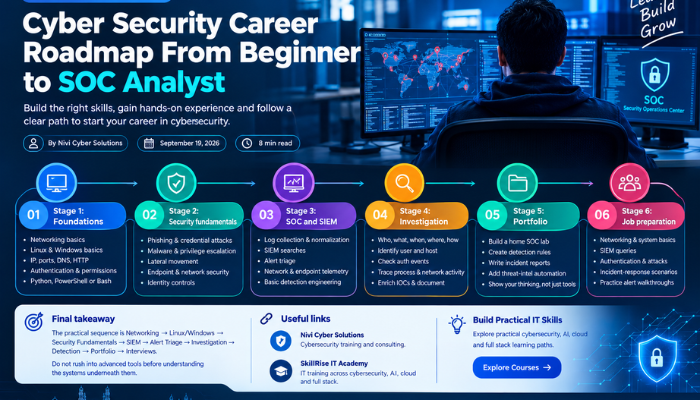
Learn networking, Linux and Windows basics. Understand IP addresses, ports, DNS, HTTP, authentication, processes, permissions and logs. Add Python, PowerShell or Bash for basic automation.
Learn phishing, credential attacks, malware, privilege escalation, lateral movement, endpoint security, network security and identity controls. The goal is to understand what attackers do and what evidence their actions leave.
A SOC Analyst works with alerts, logs, endpoint telemetry, network events and identity data. Learn log collection, normalization, SIEM searches, alert triage and basic detection engineering.
Practice answering who, what, when, where and how. Identify the affected user and host, examine authentication events, trace process and network activity, enrich IOCs, determine scope and document containment.
Build a home SOC lab, detection rules, incident write-ups, threat-intelligence automation and investigation reports. Your portfolio should demonstrate how you think—not just screenshots of tools.
Prepare for networking, Windows/Linux, SIEM queries, authentication, common attack techniques and incident-response scenarios. Practice explaining an alert from first observation to final disposition. SkillRise lists SOC among its flagship cybersecurity training areas.
Final takeaway: the practical sequence is Networking → Linux/Windows → Security Fundamentals → SIEM → Alert Triage → Investigation → Detection → Portfolio → Interviews. Do not rush into advanced tools before understanding the systems underneath them.
Explore practical cybersecurity, AI, cloud and full stack learning paths.
SkillRise IT Academy is an IT training institute in Hyderabad offering practical courses for students, fresh graduates, and working professionals. Learn from experienced trainers, work on live projects, gain practical skills, and get career and placement support.
© 2026 SkillRise IT Academy. All Rights Reserved.